
Mark Murdock
Helping parents understand the architecture underneath the new learning systems so they can independently evaluate them.
Why Connect?
If you believe parents are:• Struggling to understand how emerging learning systems actually work• Having difficulty distinguishing these systems from traditional education and from one another• Skeptical of emerging learning systems, at least in part because they don't yet understand how they workThen we're aligned.Currently, I'm building a curriculum to help parents understand the architecture underneath these systems so they can develop an informed perspective, ask entirely different kinds of questions, and evaluate the systems for themselves. I want parents to be able to see things they cannot currently see.A Real-Life Example of the Problem I'm Trying to SolveAt a prospective-parent meeting I attended this fall, a father asked school officials a question that has stayed with me ever since.“What if my son isn't a good test taker?”That question illustrates the problem I'm trying to solve.What if that father understood how the school's learning system actually worked? If he did, he could ask questions like:- How does the system determine what my son knows and doesn't know right now?
- How does it use that information to determine what he should work on next?
- How does it know whether he's learning and adjust accordingly?I'm developing a curriculum to help parents understand these systems well enough to ask questions like these.Read the full story hereIf you're involved in advancing these new learning systems in any capacity, recognize these challenges, and believe they're worth solving, I'd welcome the opportunity to show you what I've built and hear where you think it breaks or could be improved.My background: father of three, 15 years coaching, 30 years in business.You can reach me directly by email here.
What I'm Working On
Current WorkI'm building a curriculum to help parents understand emerging learning systems.Below are four selected pieces from the curriculum, shown here so you can see the method and the register.Additional examples can be found in the My Work section.Why This Subject Is A Challenge for ParentsEducation is a high-stakes, deeply personal subject. And it is a sacred institution. Traditional systems have their staunch defenders. Emerging learning systems have their advocates. Claims and counterclaims are everywhere.For parents, separating what's true, what's meaningful and what matters (and what doesn't matter) from what's merely persuasive is difficult, especially when they don't yet have a framework for understanding how these systems actually operate.Longer-Term ObjectiveDevelop a process-based evaluation framework and scorecard to compare the learning systems used by different schools.
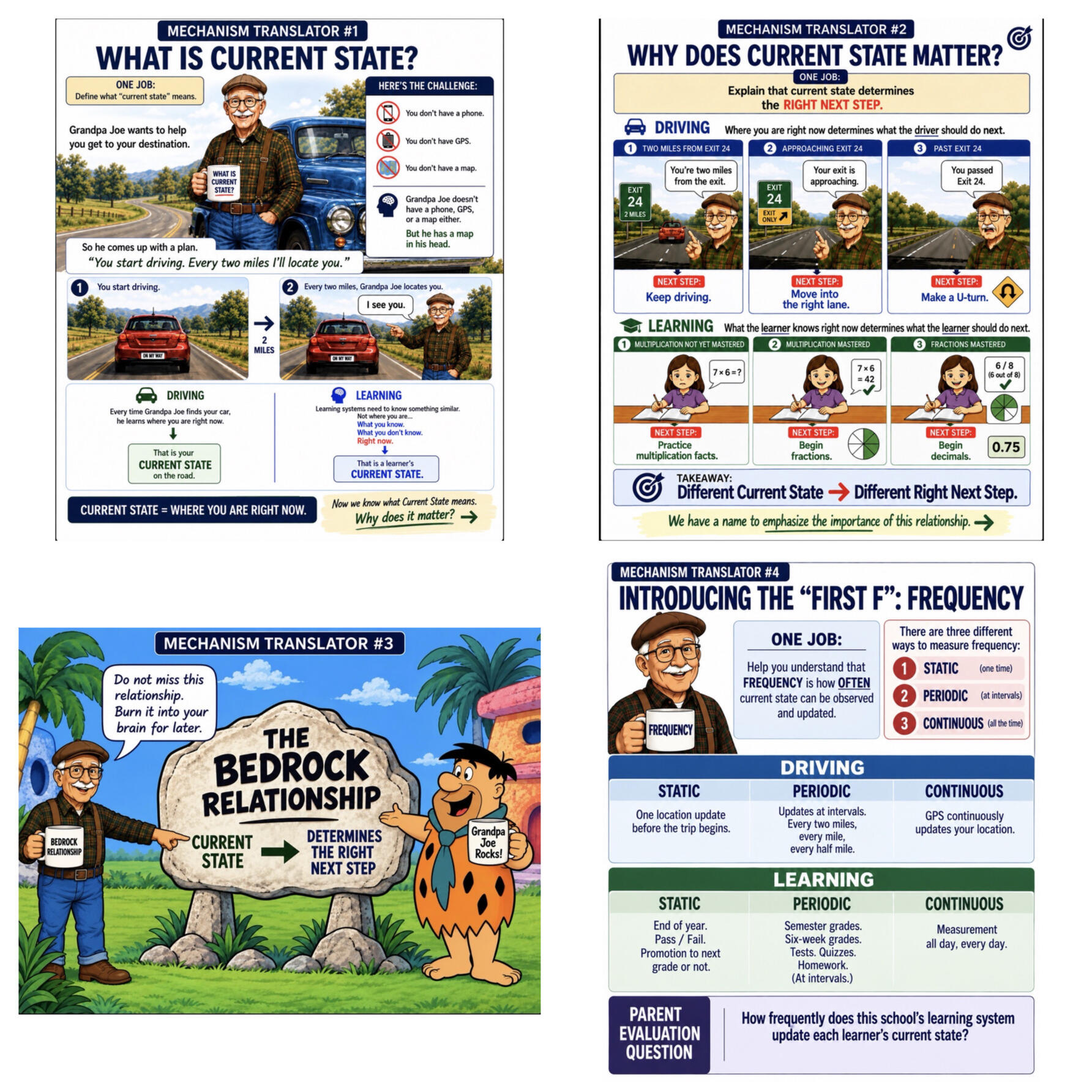
My Approach
Building This CurriculumEmerging learning systems are complicated, unfamiliar to many parents, and difficult to evaluate. Parents bring varying levels of understanding to the subject, along with their own life experiences, perspectives and questions.No single explanation or teaching technique is going to work for everyone.That’s why I’m taking a multifaceted approach to developing this parent-facing curriculum. The goal is to make the subject approachable, understandable, memorable, and ultimately useful, so parents can evaluate these systems for themselves.The approach includes:• Common vocabulary - Establish a shared language so people can communicate clearly, recognize important concepts, and understand what others are describing.• Breaking things down - Divide complicated subjects and processes into smaller, understandable pieces that can be learned and connected over time.• Familiar examples and analogies - Use situations people already understand to introduce ideas and processes they haven’t encountered before.• Investigations - Examine how familiar processes actually work, looking beyond outcomes to understand the decisions, relationships, and mechanisms underneath them.• Pattern recognition - Identify important relationships and recurring patterns, then investigate whether those patterns appear in other domains and hold up under examination.• Storytelling - Build understanding through stories people can follow, remember, and reconstruct, even when they can’t recall every abstract concept.• A relatable, skeptical guide - Use Grandpa Joe as a curious investigator who asks questions, challenges assumptions, and gives readers permission to question things they don’t understand.• Visual representations - Associate important ideas and patterns with memorable images that help readers recognize, recall, and reconstruct what they’ve learned.• Motivation through early payoff - Give readers opportunities to experience the usefulness of what they’re learning, building curiosity and a reason to continue.• Testing for transfer - Apply the patterns identified in one investigation to other familiar domains, examining whether they remain useful beyond the original example.These techniques are designed to work together, each addressing a different challenge in helping parents understand and eventually evaluate emerging learning systems.Connecting With and Developing PeopleWhether as a parent, coach, business professional, or simply in my relationships with others, I’ve tried to follow a consistent set of principles.During 15 years of youth sports coaching, I developed an operating system designed to help kids build confidence through participating in my program.It was built around five pillars:1. See and treat each kid as an individual.
2. Insist on and obsess over the correct fundamentals.
3. Put players in a position to contribute meaningfully, and then help them do so.
4. Teach the “what” and the “how,” but most importantly the “why.”
5. Create something players (and parents) are proud to be part of.These pillars aren’t independent or sequential. They work together, require constant attention, and demand continuous observation, correction, and adjustment.Over time, I learned to understand the system well enough to recognize where individual players were, where the team stood, what needed attention, and how to keep making progress.Although developed through coaching, the underlying principles reflect how I’ve approached parenting, professional relationships, and working with people more broadly.
My Work
Selected WorkThese documents illustrate how I'm investigating instructional processes and developing a curriculum to help parents better understand emerging learning systems.Introduction to the CurriculumMeet Grandpa Joe, An Orientation, and Curriculum at a Glance.Read the introductionThe Problem I'm SolvingAn explanation of the problem I'm trying to solve and why it matters.Read the documentAn Investigative MethodAn example of the investigative method I'm developing to help parents understand unfamiliar processes and systems.Read the documentBill Walsh–Joe Montana InvestigationAn investigation designed to let readers experience the "payoff" of understanding an instructional architecture before deciding whether to invest the time and effort to learn it.Read the investigationRandy Smith–Scottie Scheffler Golf InvestigationAn investigation into how a coach helps a player improve and decides what to teach.Read the investigationThe 3 PatternsHow three instructional patterns emerged from the Randy Smith-Scottie Scheffler golf investigation, and how I designed the learning experience to help readers recognize and remember those patterns.Read the documentCoaching & Organizational DesignWhy Are These Coaching Documents Included?Because they're directly relevant to what I'm working on today.My objective as a coach was to personalize the process for each individual player. Figure out what made each player tick so that I could coach them accordingly.That meant trying to understand where each player was, determining what they needed to work on next, and creating as many opportunities as possible for each player to execute quality reps at the right difficulty level, while adjusting appropriately as the player developed.All of this had to happen in the context of coaching an entire team.I got better at it over the years. But there were obvious human limitations to how closely any coach could monitor and respond to every player's individual needs simultaneously.Those limitations weren't something I spent time worrying about. They were simply part of the reality of coaching at that time.That's why these new individualized learning systems fascinate me.They claim to do something I had always assumed was impossible: continuously determine where each learner is, identify the appropriate next step, observe the results, and adjust—for many learners simultaneously.I'm investigating how these systems work and whether they can actually deliver on that promise.Selected Coaching DocumentsThese documents illustrate the manual approach I developed to individualize coaching, along with the operational and organizational systems I built to support it.Initial Email to ParentsThe introductory email parents received at the beginning of each season.View documentParent Meeting AgendaAgenda for a meeting that took place after the 2nd practice of each season. I wanted the parents to know my background and philosophy from the very beginning.View documentCoaches Meeting AgendaAgenda for a mandatory two-hour meeting held after the 2nd practice for parents who wanted to help me coach.View documentWritten Practice Agenda: First Practice EditionSent to all coaches four hours before the first practice. The warm-up section includes additional detail because players and coaches were still learning the routine.View documentWritten Practice Agenda: Mid-Season EditionSent to all coaches four hours before practice. A written agenda was created for every practice throughout the season. By mid-season, the warm-up required less detail because the routine had become familiar. *Note: I personally ran the warm-up all season to make sure that proper technique was emphasized and attention to detail never wavered.View documentLion Heart Football Coaching AwardI received this award in 2016. It is presented by the Spring Branch Memorial Sports Association (SBMSA) Football Board. The link below contains nomination letters submitted on my behalf from the parents of my players.View the nomination letters48 Lessons Learned from 15 Years of CoachingA collection of reflections on coaching, teaching, player development, confidence building, and lessons learned, posted on X for 48 consecutive days.View document
About Me
Who I amFather of three sons. Thirty-year business professional in Houston. Fifteen-year youth sports head coach.Things that matter to meHelping kids build confidence. Recognizing people's gifts and giving them the respect they deserve. Helping parents recognize the progress their children are making, even when they may not be able to see it themselves. Breaking complicated things down into understandable pieces. Challenging conventional thinking. Helping people make unfamiliar things familiar. Sharing what I’ve learned when I can help someone else. Coaches who want to make a difference. Sending unexpected packages to people I care about for no particular reason.My Background
Sold complex solutions to Fortune 100 companies and developed and led client relationships. Designed coaching programs, trained coaches, and built organizational training and operating systems. Married my high-school sweetheart, a former UT golfer and LPGA Tour player. Started at quarterback for the University of Texas while graduating from The Plan II Honors Program, a first in 50 years. Went deep on an entrepreneurial concept that didn't cross the finish line, but the learning was enormous and led directly to what I am working on today. Once played 18 holes with Tiger Woods.